


High-Value Targeting
Find what an attacker would go after first.
High-Value Targeting autonomously identifies the crown jewels in your environment — the executive identities, lead technical staff, production systems and virtualisation infrastructure an attacker would target first — and maps each to real business risk in financial, operational and reputational terms. So your team works the handful of assets driving most of your exposure, not a flat list of thousands.
Thousands of findings. Which ones actually matter?
Security teams face thousands of vulnerabilities and exposures but struggle to know which truly matter most. Traditional reports tell you what an attacker can do — not what a real adversary would go after in your environment. High-Value Targeting determines your top business risks based on what an attacker would target first.
Continuous insight into your crown jewels
High-Value Targeting pinpoints the crown jewels — executive identities, lead technical staff, production systems and virtualisation infrastructure — and maps each to financial, operational and reputational impact. That is continuous insight into your crown jewels, not a point-in-time snapshot: your team focuses on the handful of assets driving most of the risk, and leaders get board-ready insight into what is at stake.
Autonomous crown-jewel identification
NodeZero ingests identity taxonomy, credential patterns and file-system context, then uses graph-based reasoning and open-source intelligence to infer which users and systems are business-critical — from names, group memberships, access paths and organisational-unit hierarchy.
Testing prioritised on what attackers value
Once targets are auto-tagged, NodeZero prioritises the attack paths that compromise them — performing lateral movement, privilege escalation and chaining exposed credentials using advanced semantic reasoning. You see exactly how an attacker would reach your most critical assets, proven end to end.
Tagged everywhere you look
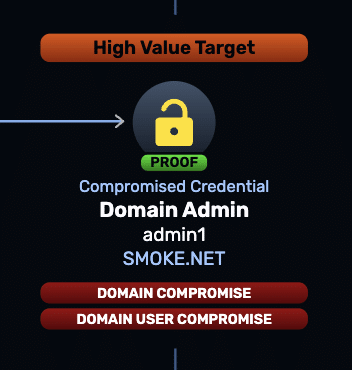
High-value targets and their business risks are flagged across the Attack Graph, Real-Time View, Impacts, Weaknesses, Credentials, Hosts and executive reports — so what is at stake, and why, is clear at a glance.
Auditable, AI-generated reasoning
Every classification is backed by an explanation in the action logs — why this identity or system matters: executive credential reuse, a sensitive organisational unit, or shared access to a regulated system. NodeZero’s GenAI replayability means that reasoning is regenerated and re-walked on demand, giving you an auditable trail you can put in front of a DISP or ISM assessor as evidence, not assertion.
Simple configuration
High-Value Targeting runs autonomously and by default on internal, phishing and insider-threat tests. You choose which tests run — no separate install, no graph-wrangling, no custom queries — and every high-value target is categorised in NodeZero with its inference logged for transparency and audit.
Board-ready language, automatically
Exploits map to categories like Operational Disruption and Executive Impersonation — the language your board and your regulator understand. For organisations carrying SOCI, CPS 230 or DISP board accountability, that turns a technical finding into a defensible statement about who an attacker could impersonate and exactly what they could reach.
From a flat list to the risks that count
Identify risk, not just exploits
Exploits map to business-impact categories, giving your team board-ready language that resonates with leadership.
Autonomy, not manual tuning
NodeZero prioritises, auto-tags and tests high-value targets autonomously. No manual labelling, no custom rules, no graph-wrangling.
Runs by default
High-Value Targeting runs automatically on internal, phishing and insider-threat tests — no separate install.
See what an attacker would target first.
Run a crown-jewel test against your environment with the Drochaid team.