


NodeZero Rapid Response
AI weaponises exploits in hours. Patch cycles are still weeks.
The accelerated pace of AI-enhanced exploits is overwhelming security teams — AI weaponises exploits in hours, while patch cycles are still weeks or longer. NodeZero Rapid Response replaces manual triage with proof of actual exploitability: production-safe, live-fire testing for newly released and actively exploited CVEs. This is not a scan or a simulation — it confirms whether an exploit actually works in your environment, often within hours of disclosure.
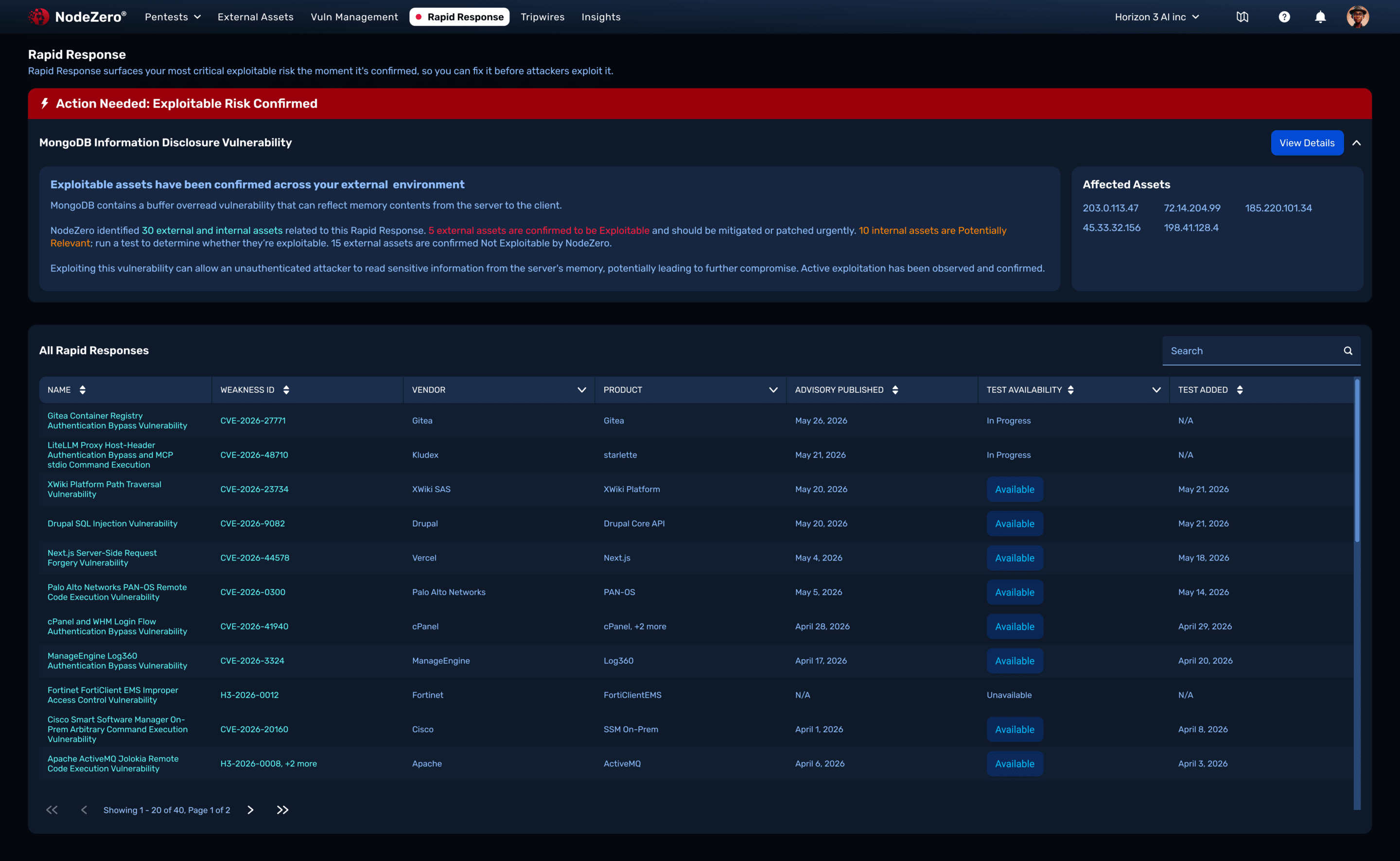
AI is accelerating the weaponisation of exploits
AI weaponises exploits in hours, while patch cycles are still weeks or longer. Rapid Response identifies which emerging vulnerabilities actually pose an exploitability risk within your environment — so you can prioritise fixing what is at risk, and justify what can wait.
Combat Mythos hysteria
Cut through the noise of new vulnerabilities, prove what is exploitable, and answer the critical question "are we safe?" before an actual attack.
Justify prioritisation with evidence and business impact
Understand your exposure and business impact to prioritise resources on fixing what reduces the most urgent risk before attackers can strike. Exploitability is confirmed with evidence — not CVSS scores from vulnerability scanners or vendor advisories.
Close the exploit window
Bridge the operational gap between your security and IT patching teams, shrinking exposure windows. Integration into existing tools and workflows, combined with personalised guidance, enables seamless and efficient hack, fix, verify flows.
Prove risk reduction
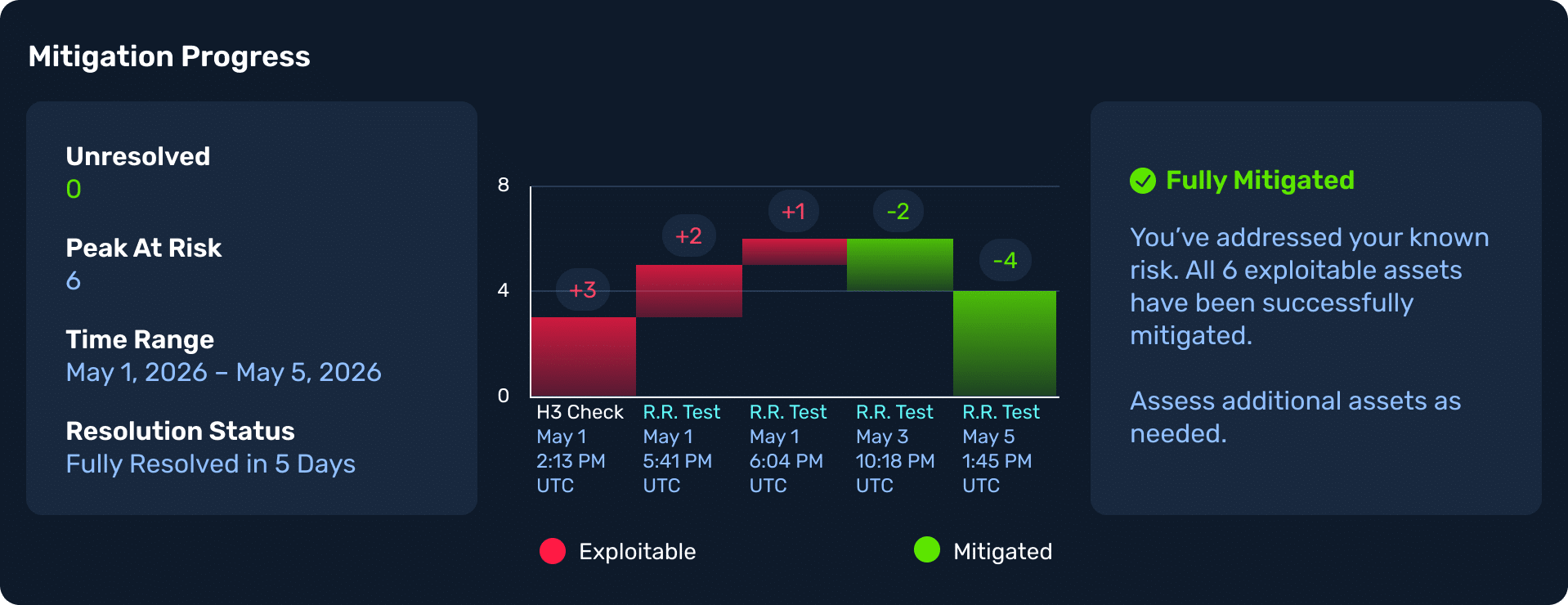
Close the loop with definitive proof that mitigation or remediation worked. Move from measuring the number of tickets to measuring the effectiveness of risk reduction and business resilience efforts.
Same-day N-day testing, even at scale
You can shorten the critical timeframe for testing N-day exposure even in large organisations by pre-configuring runners for each of your major network segments. When a widespread N-day emerges, you can run those preconfigured segments concurrently, so your full environment can be tested the same day. Every test is production-safe and runs the actual exploit live, so the result is proof — not a version check — and the NodeZero platform scales to support the largest networks.
Expert attack team
The Horizon3.ai Attack Team continuously monitors the global threat landscape and its own threat-intelligence sources to deliver advance notice of emerging exploitable vulnerabilities affecting assets organisations have previously tested on the NodeZero platform. As soon as a new vulnerability is disclosed, the team assesses its exploitability and relevance — and if it is easy to weaponise and widely used, builds a production-safe exploit into NodeZero as a targeted test, often within hours.
Single-threat focus, real exploit execution
Each Rapid Response test validates one critical threat — often tied to a known CISA KEV or a trending exploit in the wild. NodeZero runs the actual exploit in production, showing whether you are truly exposed — no full pentest required.
Built for immediate decision-making
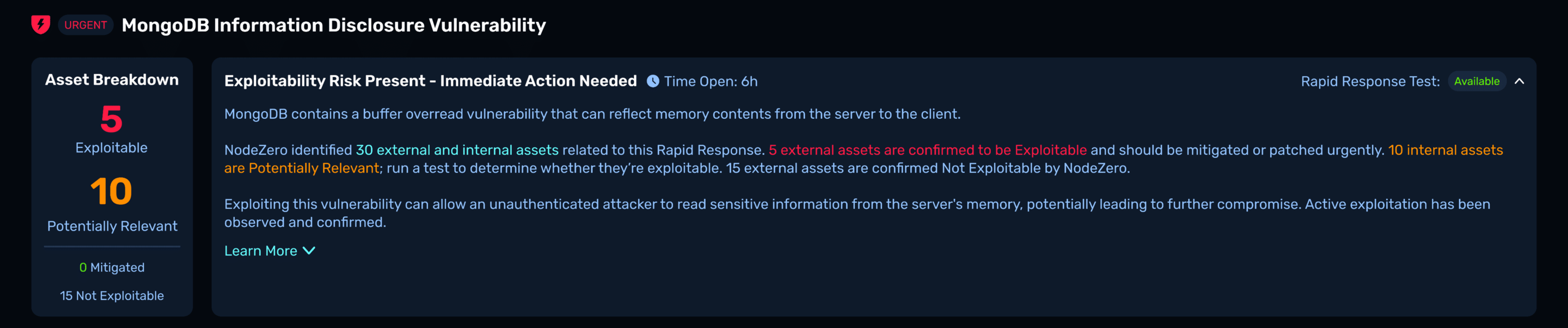
The result is a clear answer: are you exploitable or not? For each Rapid Response alert, the Horizon3.ai Attack Team does the initial triage for you, clearly identifying where your external environment is exploitable or not exposed to this risk, as well as internal assets that may be exposed and need to be tested. Each finding includes affected assets, execution paths, and whether defences intervened — so you can get right to escalating and prioritising the most urgent exploitable risk, or gain the confidence to focus elsewhere.
What your security team can prove
Rapid Response turns an emerging-threat scramble into evidence you can put in front of a stakeholder. You can prove you are covered against KEVs before they are catalogued, because many Rapid Response tests run ahead of CISA KEV coverage. You can confirm — not just suspect — that a given CVE is exploitable in your environment and on exactly which assets. And you can show you respond to critical CVEs same-day, triaging and validating risks often within hours of disclosure, then proving the fixes worked. And because every new test becomes a control check — tied to risk and real attacker behaviour, not just headlines — you can show you have operationalised threat intelligence. When a CVE drops and your board, a DISP security officer, or an APRA CPS 234 or SOCI-CIRMP regulator asks "are we affected?", you can answer the same day — with proof.
Citrix NetScaler CVE-2025-7776: tested before the vendor advisory
For the Citrix NetScaler memory corruption vulnerability (CVE-2025-7776), Horizon3 began Rapid Response work on 10 July 2025 and disclosed the zero day to the vendor on 11 July 2025 — weeks before the vendor advisory landed on 26 August 2025, the same day the exploit was added to NodeZero. It is a concrete example of the disclosure-to-defence gap closing in your favour: customers had a path to validate exposure long before the public advisory.
Flare Alerts: opt-in early warning grounded in evidence
Some Rapid Response vulnerabilities align with conditions already seen in your past NodeZero tests. With Flare Alerts, customers who opt in allow Horizon3.ai to re-analyse past NodeZero results when a new test is released; if there is a strong match, you receive a proactive alert recommending the test be run. Flare Alerts are grounded in real evidence, never speculation. They are optional and privacy-respecting — designed to help teams act early without default data retention or intrusive monitoring, which keeps the feature aligned with data-sovereignty obligations under the Privacy Act and Notifiable Data Breaches scheme and DISP data-handling requirements.
Every alert tells you where the intel came from
Rapid Response activity cards are tagged so you can see at a glance how each vulnerability was surfaced and why it matters right now. `Discovered by Horizon3` appears when the Horizon3 Attack Team identified the zero-day. `Reversed by Horizon3` appears when the team reverse-engineered a vendor advisory to build a production-safe proof of concept. `Original Research` appears when Horizon3 published original analysis outside of discovery or reversal. `Exploited in the Wild` appears when there are reports of active exploitation, often before the CVE reaches CISA's KEV catalogue. `CISA KEV` appears once the vulnerability is formally listed. `Found Among Horizon3 Clients` appears when a vulnerable application or device has been observed in NodeZero customer environments, and `Top Exploited` flags the vulnerabilities attackers are currently abusing most. The result is transparent provenance — you know whether a warning comes from public reporting, vendor advisories, or Horizon3's own research lab.
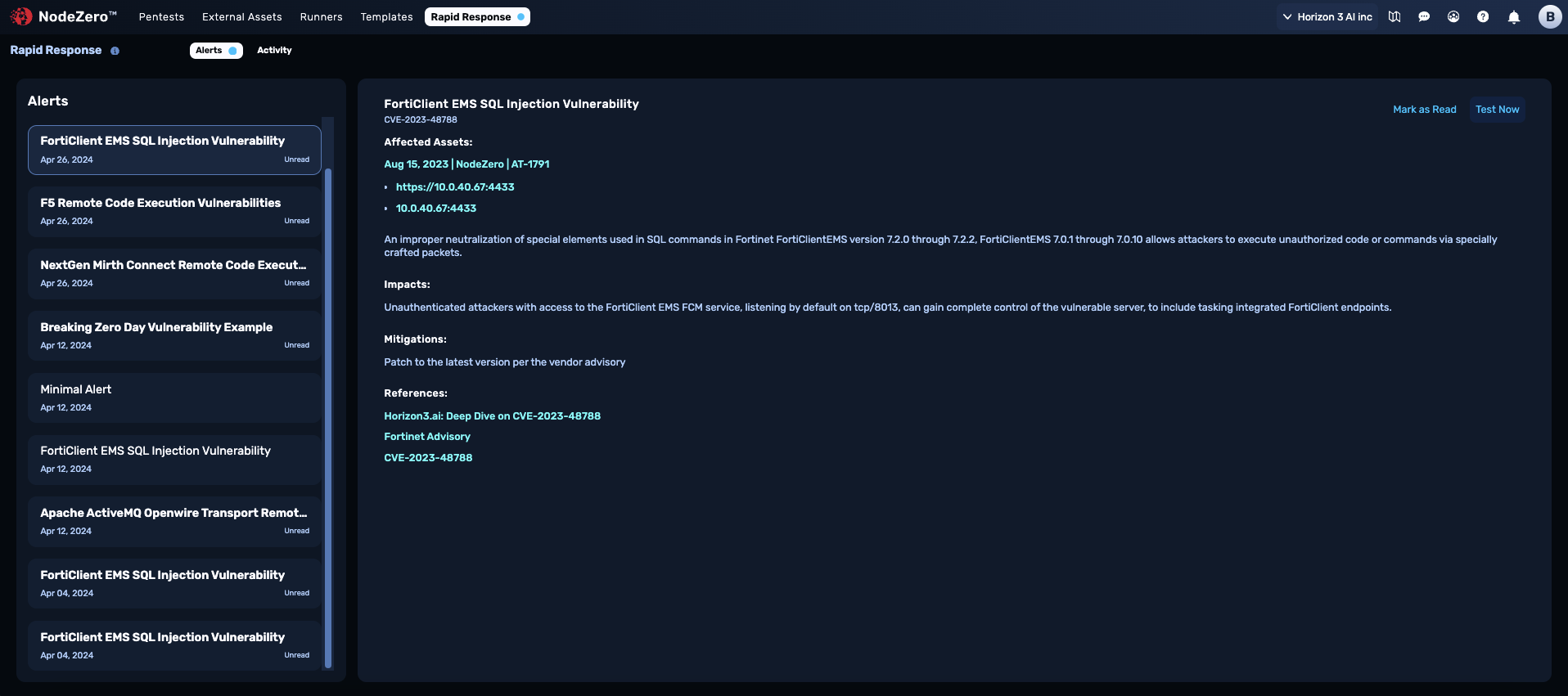
Attack research in action
Download the latest Rapid Response factsheet to understand the real-world exploitability, business impact, and validation guidance for an emerging threat. Built from Horizon3.ai Attack Team research, the factsheet helps security teams quickly determine what matters, prioritise response efforts, and prove risk reduction.
Prove what is exploitable — before attackers strike
Early identification of N-days and zero days
The Horizon3.ai Attack Team proactively researches potential zero days and N-days and identifies which vulnerabilities are likely to be exploited in the wild — even if they haven't made the CISA Known Exploited Vulnerabilities (KEV) catalogue.
Prioritise on proof, not panic
The Attack Team reverse-engineers identified vulnerabilities and builds a production-safe proof of concept to confirm real impact. Exploitability is confirmed or ruled out with evidence — not CVSS scores from vulnerability scanners or vendor advisories that just check versions. You get proof of what to fix, and justification for what can wait.
Emerging threats are verified
NodeZero users receive tailored threat intelligence on emerging vulnerabilities. This includes a manual verification by the Horizon3.ai Attack Team of the exploitability and impact of the threat, unique to your organisation.
N-day testing as standard
NodeZero pentests identify emerging N-days within your environment as part of the autonomous internal and external pentesting process. The Rapid Response section of the NodeZero Portal also enables targeted N-day testing on demand.
Find, fix, and verify emerging threats
Emerging threats identified
The Horizon3.ai Attack Team continually researches the global threat environment to identify new N-days that have been exploited in the wild or are likely to be exploited.
Users alerted
The Horizon3.ai team determines if NodeZero users are affected by the zero day or N-day. Users are alerted even before the new exploit is added to NodeZero.
N-day test added to NodeZero
The Attack Team develops a new attack module for the vulnerability, using a production-safe variant of a proof of concept if one exists or developing one from scratch if it does not.
Users understand impact and priority
Users get immediate visibility to which assets in their organisation are impacted. For maximum efficiency and scale, you can set up pre-configured tests ahead of time in all your network segments.
Users quickly fix or mitigate
If your organisation is impacted, you receive detailed remediation guidance. If a patch isn't yet available, NodeZero will offer guidance about mitigating controls, such as quarantining the server, changing firewall rules, or increased monitoring.
Users verify fixes
Once you've remediated the vulnerability, use NodeZero to run a quick verification test to prove the vulnerability is no longer present — moving from counting tickets to measuring real risk reduction.
Users test proactively
Testing your environment whenever you have infrastructure changes enables the Horizon3.ai Attack Team to better detect if you are impacted by emerging threats.
Answer "are we exploitable?" the same day
Get production-safe proof of exposure to zero-day and N-day threats with the Horizon3.ai Rapid Response service, included with the NodeZero Pro and Elite tiers.