


Why NodeZero
Scanners guess. Simulations pretend. NodeZero proves.
The only way to know your real risk is to watch a real attack unfold. NodeZero safely runs real attacks inside your environment — continuously — and shows you exactly what an adversary could reach. Not a longer list of maybes. Proof.
This isn’t theoretical coverage. This is offensive security at scale.
Capability by capability, against the tools you’re probably running today — vulnerability scanners, manual pentests, and breach-and-attack simulation.
Attack execution
| NodeZero | Vulnerability scanners | Manual pentests | Breach & attack simulation | |
|---|---|---|---|---|
| Proof of exploitation | Real, with evidence | Identifies potential CVEs | Screenshots or logs | Simulated payloads only |
| Chains full attack paths | Real TTPs, end to end | Reports isolated issues | Depends on skill | Runs atomic simulations |
| Paths to critical assets | Auto-discovers routes to your crown jewels | No crown-jewel awareness | Requires manual tagging | Static objectives only |
| Exposed credentials & data | Finds exposed credentials and sensitive data — even credentials in build logs | No business-data validation | May uncover if specifically scoped | Not part of the core test set |
| Runs in production | Safe, real attacks | Passive scans, detection only | Rarely — mostly pre-prod | Uses sandbox / testbeds |
Validation & detection
| NodeZero | Vulnerability scanners | Manual pentests | Breach & attack simulation | |
|---|---|---|---|---|
| Control validation | Validates IAM, EDR & SOC response | Doesn’t validate security tools | Sometimes | Scenario-based at best |
| EDR / endpoint effectiveness | Proves whether your EDR detects or blocks real attacks | Alerts only, no validation | Rarely tested | Simulates endpoint events |
| Built-in detection (Tripwires) | Drops Tripwires that catch live lateral movement | Not supported | Not typically included | Simulated triggers only |
| Threat-actor mapping | Maps findings to real adversary behaviour (MITRE ATT&CK) | No TTP alignment | Depends on the analyst | High-level MITRE mapping |
| Re-tests your fixes | Quick Verify | Manual rescan required | Requires a new engagement | Not built for retesting |
Coverage, speed & operations
| NodeZero | Vulnerability scanners | Manual pentests | Breach & attack simulation | |
|---|---|---|---|---|
| Environment coverage | Full stack — cloud, hybrid, on-prem | Primarily on-prem & known assets | Scoped per contract | Often limited to simulated scenarios |
| Known exploited vulnerabilities (KEV / ACSC) | Integrates exploitable KEVs within hours | Lists KEVs, no actionability | Depends on researcher turnaround | Delayed or manual integration |
| Speed to insight | Hours — autonomous, minimal setup | Hours to days (scan time only) | Weeks to complete & report | Days to configure & interpret |
| Scale & repeatability | Unlimited, concurrent, repeatable | Scales with alerts, not accuracy | Limited by human resources | Limited by test coverage |
| Workflow integration | Native API — ServiceNow / Jira ready | Basic export to SIEM / ITSM | Offline reports only | Some integrations, limited feedback |
| Natural-language execution (MCP) | MCP Server runs & integrates NodeZero in natural language | Not supported | Requires expert CLI or tooling | Pre-scripted or dashboard-only |
Value & compliance
| NodeZero | Vulnerability scanners | Manual pentests | Breach & attack simulation | |
|---|---|---|---|---|
| Exploitable-risk hub | Centralises exploitable vulnerabilities, fixes & impact | Long lists, no context | Inconsistent tracking | Not designed for it |
| Executive & board value | Clear, real-world risk for the board | Technical noise, low signal | Depends on the findings | Simulated risk, hard to explain |
| Cost efficiency | Continuous validation — replaces annual-pentest spend | Low cost, high alert fatigue | Expensive, point-in-time | Platform plus tuning overhead |
| Maps to your obligations | DISP / Essential Eight / SOCI, via Drochaid | Raw CVE lists | Point-in-time report | Hard to translate |
An attacker’s path is a graph, not a list.
Real attacks don’t work down a CVE list. They chain a misconfiguration to a credential, a credential to a service, a service to your crown jewels. NodeZero maps that terrain the way an attacker sees it — then shows you the small number of paths that actually reach what matters, so you fix those first.
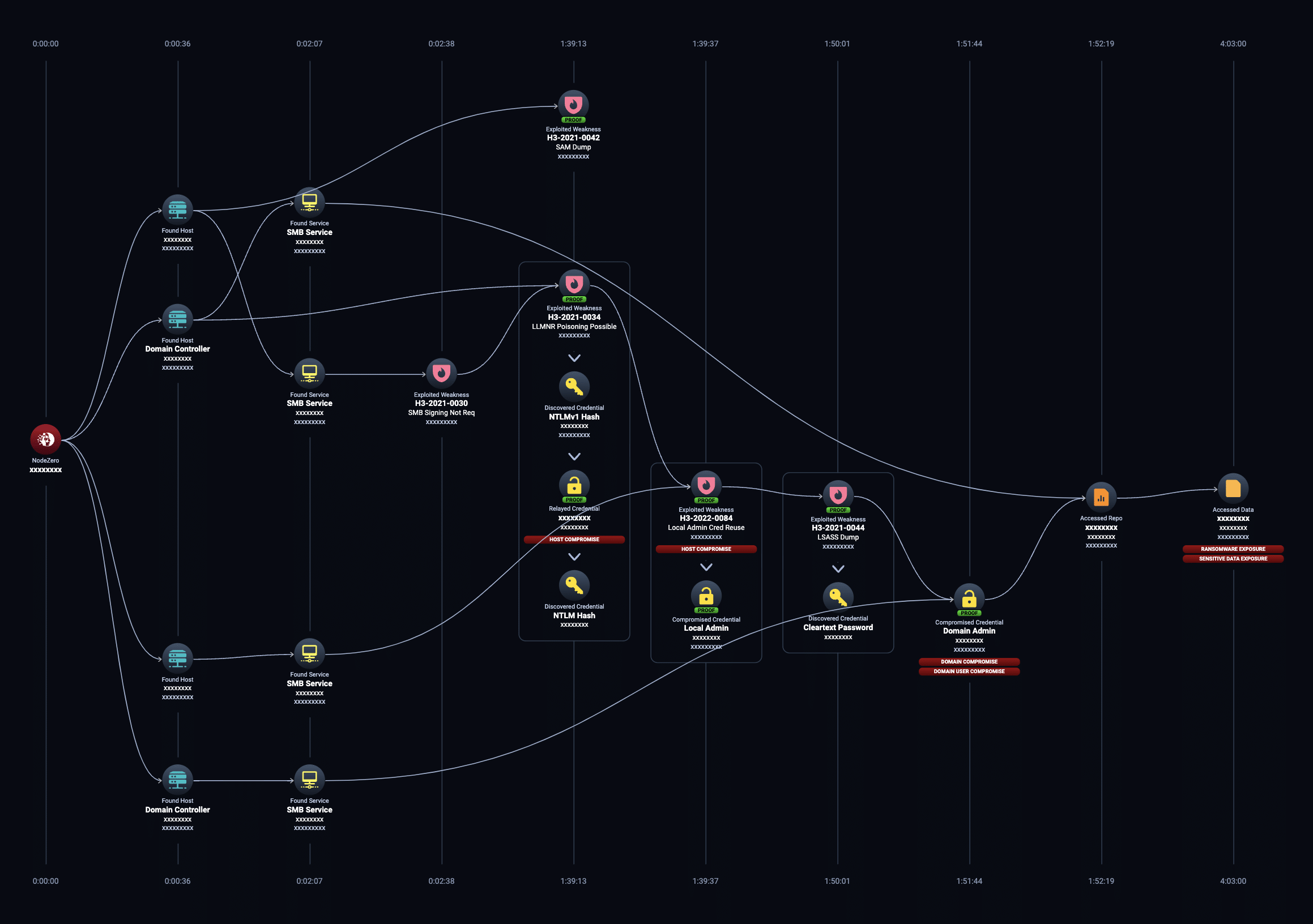
Most security tools tell you what might be wrong. NodeZero shows you what an attacker could actually do.
| Traditional security | NodeZero |
|---|---|
| Static, pre-defined tests — checks what you already know | Autonomous attacks — learns and adapts with every test |
| Theoretical risk — opinion-based scores | Proven impact — real exploitation shows actual exposure |
| Paralysing volume — endless to-do lists | Clarity — exactly what to fix now, and what can wait |
| Periodic — results go stale fast | Continuous — know the impact of every change |
| Based on assumptions — hope the tools work | Anchored in evidence — continuous proof |
One platform, not another tool on the pile.
NodeZero is your primary offensive-security platform. It replaces the once-a-year penetration test, the scanner noise and the breach-and-attack-simulation treadmill with one continuous source of proven, prioritised risk — fewer tools, not another tool. It works on its own: point it at your environment and it tells you what an attacker could reach, what to fix first, and proves it.
The one thing it doesn’t replace is your IRAP or CREST certification engagement — a formality you’ll always need a human assessor to sign. NodeZero makes that sharper too: it closes the eleven-month blind spot between engagements with continuous proof, so every assessment starts from evidence, not assumptions.
Why security teams choose NodeZero.
You uncover what’s exploitable
Across cloud, identity, endpoint and data — not just unpatched CVEs.
You operationalise every finding
Each comes with asset context, the attack path, fix guidance and one-click re-validation.
You shorten detection and response
Tripwires turn pentest insight into alerts that catch live lateral movement.
You prove your strategy works
Tune an EDR, check an IAM policy, measure posture over time — with evidence.
Proof in practice: how Dynatrace built a continuous security program with NodeZero.
One of the world’s leading observability companies moved from periodic scans to continuous, autonomous testing — surfacing and remediating real issues before attackers could exploit them.
World-class offensive testing, delivered by a partner built for the job.
NodeZero is the platform; Drochaid is the sovereign, Australian team that maps every result to the obligations you’re actually audited on. You get proof in language your auditor and your board accept — not another tool to run yourself.
See the proof for yourself.
Book a walkthrough — we’ll run NodeZero against a live environment and show you the attack paths, the proof, and the fix guidance.