


Web application pentesting
The application layer, tested like the network behind it.
NodeZero WebApp Pentesting attacks your web applications the way an adversary would — testing authenticated, role-based workflows for OWASP Top 10 weaknesses, broken access control and business-logic flaws, across internally and externally facing applications, safely in production.
Where web applications actually break:
OWASP Top 10 and common CWEs
Injection, cross-site scripting, XXE and server-side request forgery — found by exploitation, not by pattern match, so what you get is the weaknesses that actually work.
Access control that fails under a real user
Broken access control, insecure direct object references and broken object-level authorisation — the flaws that let one user, tenant or role reach another's data.
Business logic
The flaws scanners routinely miss, because they are not a bad pattern in the code — they are a legitimate sequence of steps the application should never have allowed.
Authenticated, role-aware workflows
Testing runs through real user journeys with credential and multi-factor authentication support, so the application is exercised the way your customers and staff actually use it.
Modern application surfaces
Single-page applications and REST, SOAP and GraphQL APIs, discovered through headless-browser crawling rather than assumed from a list someone maintained by hand.
Pre-production and production
The same production-safe engine that runs NodeZero's internal, external and cloud pentests — so applications can be tested before release and continuously after it.

Web applications have become the front door to the enterprise, but most security teams are still testing them as if they exist in isolation.
Attackers exploit business logic, abuse identity, and move laterally across cloud and infrastructure. With NodeZero Web App Pentesting, we give security teams a continuous, production safe way to think and operate like an attacker, validate real risk, and focus remediation where it actually reduces business risk.
Two different questions
An application can sit on a perfectly hardened network and still hand an attacker another customer's records. That is because infrastructure testing and application testing ask different questions, and neither answer covers the other. NodeZero now runs both, so the gap between them stops being where the breach happens.
Infrastructure layer
- Servers and network services
- Firewalls and VPNs
- Ports and the surrounding environment
“Can someone break in, or move around once they are in?”
Application layer
- Logins and permissions
- Input fields and APIs
- Sessions and user workflows
“Can someone misuse the application itself?”
Attackers do not respect the boundary between them
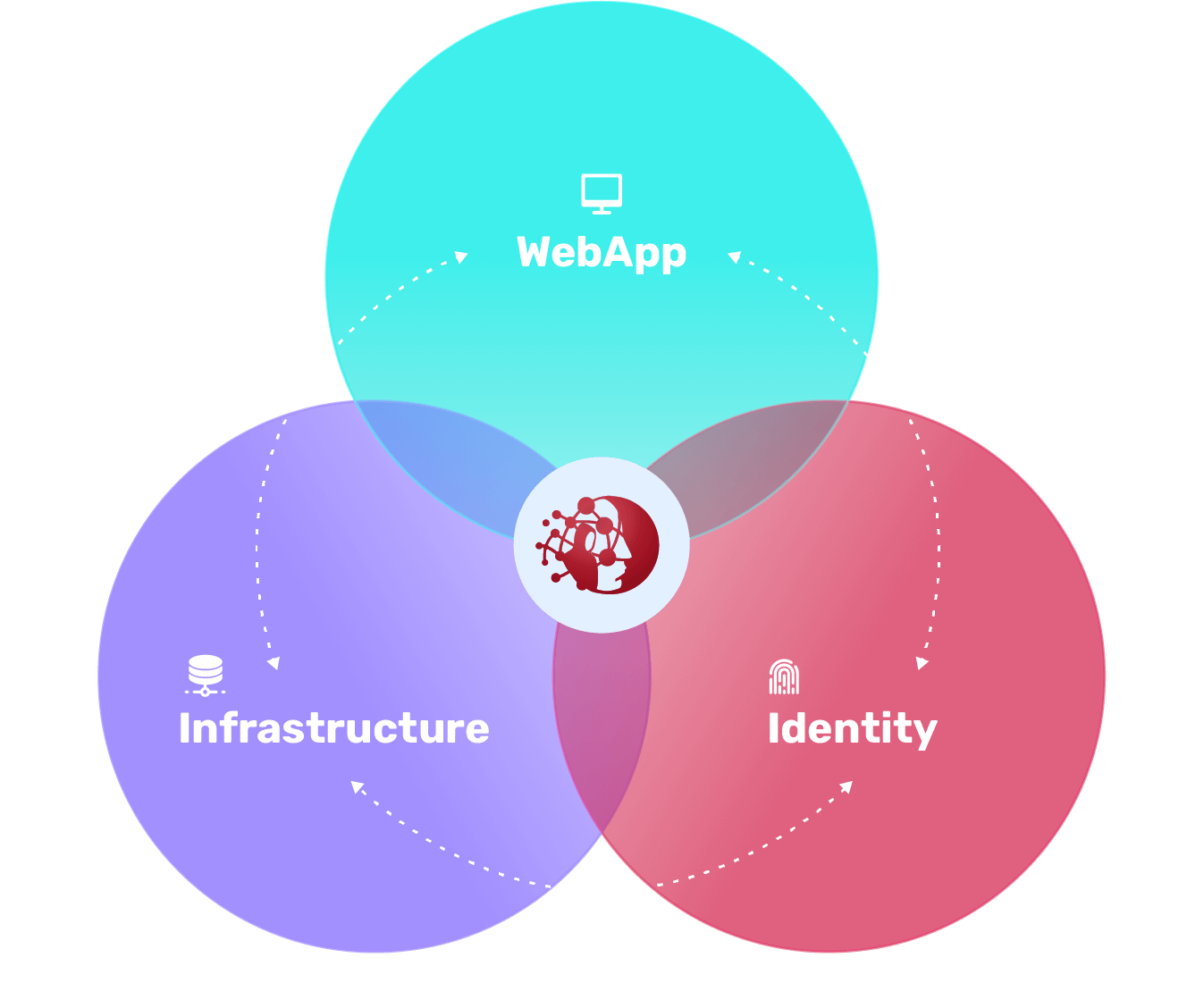
Testing scopes create seams. The application test ends at the application; the infrastructure test starts behind it; and the hand-off between them — a stolen credential, an abused cloud identity — is where real intrusions succeed. NodeZero attacks web applications, infrastructure and identity on one platform with one scope, so the seam an attacker would use is tested rather than assumed safe.
The gap between the tools you already run
Every approach to application security trades noise, misses or cadence against the others. The result is a remediation queue that outgrows the team working it, or a test that lands long after the release it was meant to check.
What you run today
- Static and composition analysis — continuous, but the queue outgrows the team
- Dynamic scanning — noisy and lossy at the same time
- Manual penetration test — human judgement, about once a year
- Bug bounty — real findings, on nobody's schedule
What web application pentesting adds
- Findings raised with the exploitation that proved them attached
- Testing on your release cadence, not an annual one
- Access-control and business-logic flaws scanners routinely miss
- The attack path followed on past the application itself
The result is a shorter, truer queue
The queue is ordered by what an attack actually achieved rather than by severity score. That is the difference between a remediation list a team works through and one it learns to ignore.
Three ways organisations use it
A web application pentest is not only for the team that wrote the application. The same test serves three situations that look nothing alike: buying software you cannot see inside, customising a commercial product until part of it is yours, and shipping software other organisations have to trust.
Buying software, not building it
- A pentest report is evidence of vendor maturity — and of the residual risk you are accepting
- Ask sharper questions about access control, multi-factor authentication, logging and monitoring
- Support procurement, governance, compliance and renewal decisions with findings, not assurances
Risk validation, not hands-on code remediation — confidence to buy, renew or push for improvement.
Customising a commercial product
- A strong base product says nothing about the workflows, configuration and integrations you added
- Local customisation is where weak permissions and unsafe data flows get introduced
- Every connection belongs in scope — APIs, identity, payments and third parties
A ranked fix list for the team that built the customisations, re-tested to prove the fixes held.
Shipping software to customers
- Validate that secure coding and release processes really work — not just that they exist
- Give security operations the authentication, access-control, input and integration issues worth acting on
- Feed the lessons back into continuous integration, code review and secure development
- Produce the evidence sales and customer security reviews ask for
A continuous loop that aligns development and security operations — safer delivery, and customer trust earned with evidence.
The moments that call for a test
Annual testing assumes risk arrives on a schedule. It does not — it arrives with change, and the moments that raise it are predictable enough to plan around.
A new launch
Before a new application or API goes live — so it launches tested rather than exposed.
A major change
After a big release or redesign, when new weaknesses tend to appear soon after old ones were fixed.
Sensitive data
When an application begins handling customer or payment data — the consequence of a flaw has changed even if the code has not.
Audits and due diligence
During a compliance audit or an enterprise customer's security review, when someone else needs evidence rather than assurances.
On a schedule
Recurring tests for high-risk systems — because the application that is never retested is the one that drifts.
Australian and New Zealand compliance
Because NodeZero exploits a weakness rather than reporting that it exists, what a web application test produces is compliance evidence — proof a control failed, or proof it held. Thirteen frameworks carry controls a web application test produces evidence for. Here is where it lands in each, and every mapping also states what still needs separate evidence.

Multi-factor authentication at ML1 — testing the customer-facing and third-party authentication surfaces that hold sensitive customer data for exploitable weaknesses that get past the factor.

Section 8(2) cyber hazards — where the critical infrastructure asset includes customer or operational web applications.

The internal and external penetration testing requirements, 11.4.2 and 11.4.3, where PCI's testing methodology expects application-layer coverage; 6.2.1 covers securely developed bespoke software.

A.8.28 secure coding and A.8.29 security testing in development and acceptance, plus A.8.3 access restriction and A.8.8 technical vulnerabilities.

CC6.3 turns on whether the audited application enforces its own access model, with CC6.1 covering logical access more broadly and CC7.1 the identification of new vulnerabilities.
ISM-0402 — software comprehensively tested for vulnerabilities before its initial release, before each subsequent release, and periodically. The control names static, dynamic and composition analysis; web application pentesting sits alongside them with proof of what is exploitable.

APP 11.1 reasonable steps, and the OAIC guidance expecting ICT systems to be tested during development and once operational.

IPP 5(a) — whether a customer portal lets one person reach another person's information.

14.4.6 — software reviewed or tested for vulnerabilities before it reaches production, and tested by an independent party as well as the developer.

Paragraph 27 systematic testing — extending the programme to the applications customers and members sign in to.

ID.RA-01 — identifying and validating vulnerabilities in assets, extended to the bespoke applications infrastructure testing does not reach.

ARCHITECTURE-4h at MIL3 — periodic security testing of in-house-developed and in-house-tailored applications.

The same ARCHITECTURE-4h practice, inherited by the Australian energy sector framework.
Four things a scanner does not do
NodeZero runs the same production-safe engine behind its internal, external and cloud pentests. Pointed at the application layer, that changes four things.
It finds the endpoints your inventory missed
A headless browser drives the application the way a person does, so single-page routes and REST, SOAP and GraphQL endpoints surface from behaviour rather than from a list someone remembered to update. Shadow endpoints are found because they respond, not because they were declared.
It logs in as each role, not just as an anonymous visitor
Most of an application only exists after authentication. NodeZero tests with credentials and multi-factor support, in each role you give it an account for — which is the only way the interesting half of the attack surface gets touched at all.
It reaches for another user's data on purpose
Broken access control, IDOR and BOLA are not bad patterns in the code — they are a legitimate request made by the wrong account. Finding them takes two authenticated sessions and the intent to cross between them, which is why static and dynamic tooling so rarely finds them.
It does not stop at the application boundary
When an application weakness yields a credential, the test keeps going — into the infrastructure and identity behind it. You get the whole path, the proof each step worked, and the one fix that breaks the chain earliest.
See what your applications give away
Run NodeZero against your own web applications and see the access-control and business-logic flaws a scanner routinely misses — with the attack path and the fix attached.